
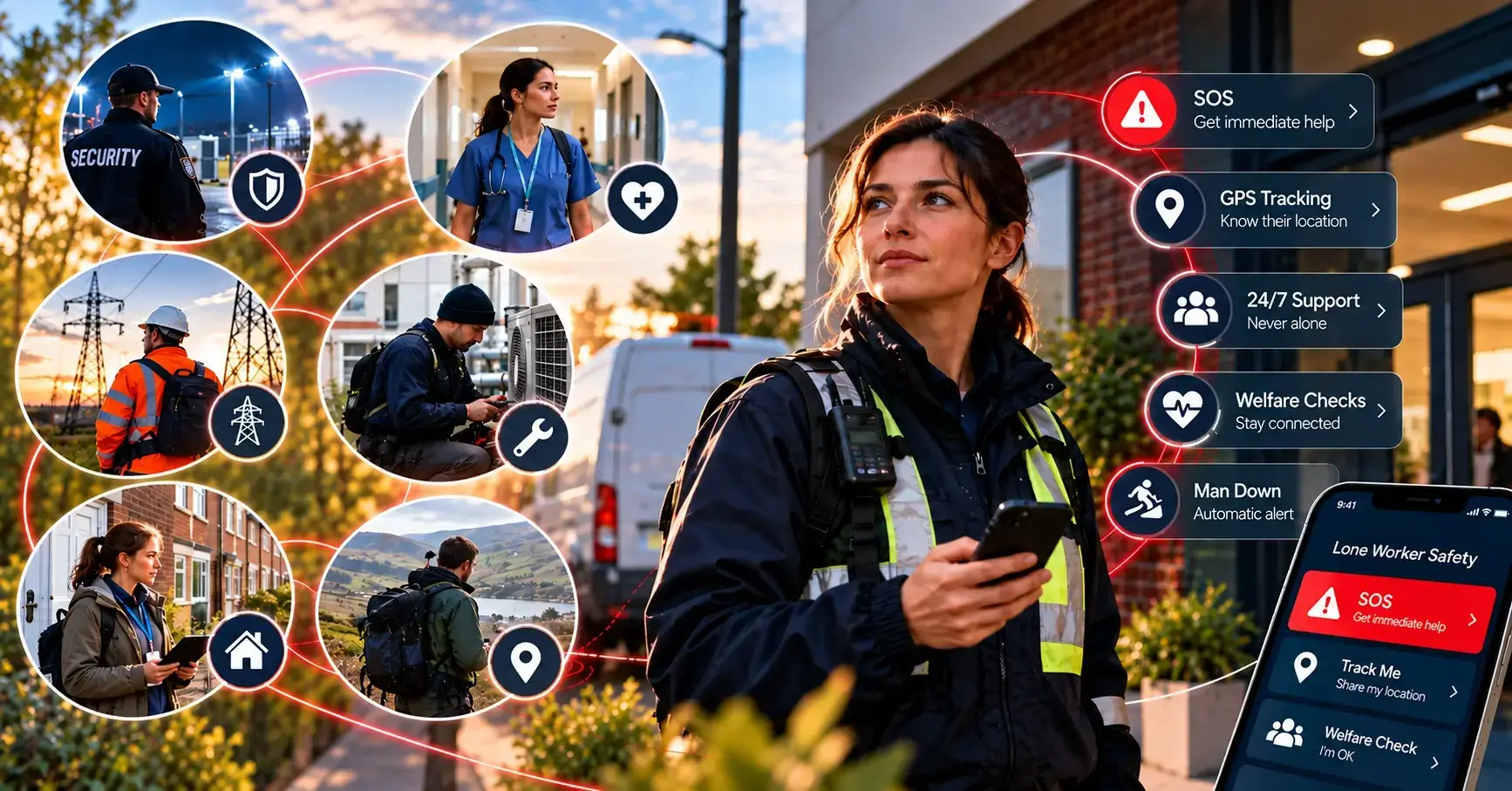
Lone workers operate across almost every sector — including security, facilities management, healthcare, housing, utilities, engineering, maintenance and field services.
The Health and Safety Executive (HSE) defines a lone worker as someone who works by themselves without close or direct supervision. HSE also recognises that lone workers can face greater risk because there may be nobody immediately available to help or support them if something goes wrong.
Traditionally, lone worker risk assessments have focused heavily on physical hazards: accidents, slips and falls, violence, medical emergencies and challenging environments.
These remain critical risks.
But effective lone worker protection should also consider another important factor: how supported and reassured employees feel while working alone.
Working without nearby colleagues or supervision can make an otherwise manageable situation feel considerably more serious. Knowing that there is a clear way to request assistance, that welfare checks are taking place and that appropriate people can be alerted when something goes wrong can make a significant difference to the lone worker experience.
The relationship between work and mental wellbeing is increasingly important for UK employers.
According to HSE statistics for 2024/25:
These figures apply to the workforce generally rather than specifically to lone workers. However, HSE expressly recognises that lone working can cause work-related stress and affect people’s mental health and wellbeing.
HSE also warns that poor contact can leave workers feeling disconnected, isolated or abandoned.
That makes communication and effective safety arrangements particularly important where employees regularly work by themselves.
The same workplace hazard may be perceived differently when no colleague or supervisor is nearby.
Consider a field engineer working in an isolated location, a security officer conducting a night patrol or a housing employee visiting someone alone.
Questions may naturally arise:
These are not simply technology questions. They are fundamental questions about confidence, communication and organisational support.
A well-designed lone worker strategy therefore needs to address what happens before, during and after an incident.
Effective lone worker protection should not mean continuously watching employees.
It should mean creating a proportionate safety framework in which workers understand:
HSE guidance states that employers should train, supervise and monitor lone workers, keep in touch with them and respond to incidents. Monitoring arrangements can include regular contact and systems for raising alarms manually or automatically.
Technology can support these arrangements, but it should form part of a wider lone-working risk-management process rather than replace it.
MiSentinelSOS is Sentinel Technologies’ dedicated lone worker and personal safety solution.
It is designed to help organisations establish clearer communication, monitoring and escalation arrangements for employees who work alone or away from direct supervision.
Rather than relying solely on the worker making a telephone call when something goes wrong, MiSentinelSOS provides multiple ways of supporting employees throughout their lone-working activity.
When a worker feels threatened, unsafe or requires assistance, they can raise an SOS alert through MiSentinelSOS.
The alert can initiate the organisation’s configured escalation process so that the appropriate people can take action.
For employees dealing with members of the public, visiting unfamiliar environments or working remotely, having a clearly defined method of raising an alarm provides an important additional layer of protection.
There may be situations where an employee cannot manually request assistance.
MiSentinelSOS includes Man Down functionality designed to support circumstances where configured movement or orientation conditions indicate that a worker may require assistance.
An alert can then be generated through the defined escalation process.
This is particularly relevant for employees working in isolated environments where an incident may otherwise remain unnoticed.
Lone worker safety should not depend solely on reacting to emergencies.
Welfare checks provide structured points of contact during a lone worker’s activity.
MiSentinelSOS supports welfare-check arrangements that allow organisations to check that workers remain safe during their duties and take appropriate action where a required response is not received.
For the worker, this can also provide reassurance that their organisation has not simply sent them out to work alone and forgotten about them.
For activities where additional visibility is appropriate, Track Me can support location-aware lone working.
This can help authorised personnel understand a worker’s location during the relevant activity and provide useful information when responding to an incident or safety alert.
Location monitoring should always be implemented proportionately and in accordance with the organisation’s privacy, data-protection and employee-monitoring arrangements.
During an emergency, knowing where assistance may be required can be extremely important.
MiSentinelSOS can provide GPS location information associated with lone-worker activity and safety events, helping authorised responders make better-informed decisions.
This is especially valuable for mobile employees who may visit multiple customer premises, remote locations or unfamiliar sites during the working day.
Technology is only effective when somebody knows what to do with the alert it creates.
MiSentinelSOS supports configured escalation arrangements, enabling organisations to establish processes for handling SOS, Man Down and welfare-related events.
The appropriate response model will depend on the organisation’s risk assessment, operating environment and monitoring arrangements.
This helps move lone-worker protection away from an informal “call somebody if something happens” approach towards a defined and auditable process.
Understanding what happened during an incident is important for both operational management and continuous improvement.
MiSentinelSOS provides reporting and audit information around safety events and activity, helping authorised managers review what occurred and identify areas where lone-working procedures may need improvement.
This can support:
Deploying an app alone does not create an effective lone worker strategy.
Organisations should consider the entire safety process.
A robust approach should include:
Identify who works alone, where they work, the activities they undertake and the hazards they may encounter.
Establish who should receive an alert and what they are expected to do.
Workers should understand how to request assistance and what alternatives exist if they are unable to do so manually.
Determine whether scheduled or activity-based welfare checks are necessary according to risk.
An alert is only useful if responsibility for responding to it is clearly defined.
Employees should understand the technology, the organisation’s procedures and what is expected of them.
Alerts and incidents should be reviewed so that lessons can be incorporated into future risk assessments and operating procedures.
Lone-worker systems and emergency arrangements should be tested regularly to ensure they continue to operate as expected.
HSE specifically recommends regularly testing monitoring systems and emergency procedures.
Technology cannot remove every risk associated with working alone.
Nor should a lone worker application be presented as a substitute for appropriate staffing, supervision, training, risk assessment or emergency procedures.
What technology can do is reduce uncertainty.
A worker can know that:
That sense of connection can contribute to a safer and more supported working environment.
It changes the conversation from simply working alone to being supported while working alone.
Effective lone-worker protection goes beyond compliance paperwork.
It means understanding the real conditions employees face when they work without close or direct supervision and putting proportionate controls in place to protect them.
For organisations, that means combining appropriate policies, risk assessments, training, supervision and response arrangements with technology capable of supporting those controls.
For employees, it means knowing that working alone does not necessarily mean facing risk alone.
MiSentinelSOS helps organisations provide that connection through SOS alerts, Man Down functionality, welfare checks, Track Me, GPS-enabled location information, structured escalation and reporting within a dedicated lone-worker safety solution.
If your organisation employs people who work alone, remotely, in the community or away from direct supervision, it may be time to review whether your existing arrangements provide the level of protection and reassurance your workforce requires.
Speak to Sentinel Technologies about MiSentinelSOS and discover how a structured lone-worker safety solution could support your employees and your organisation.