

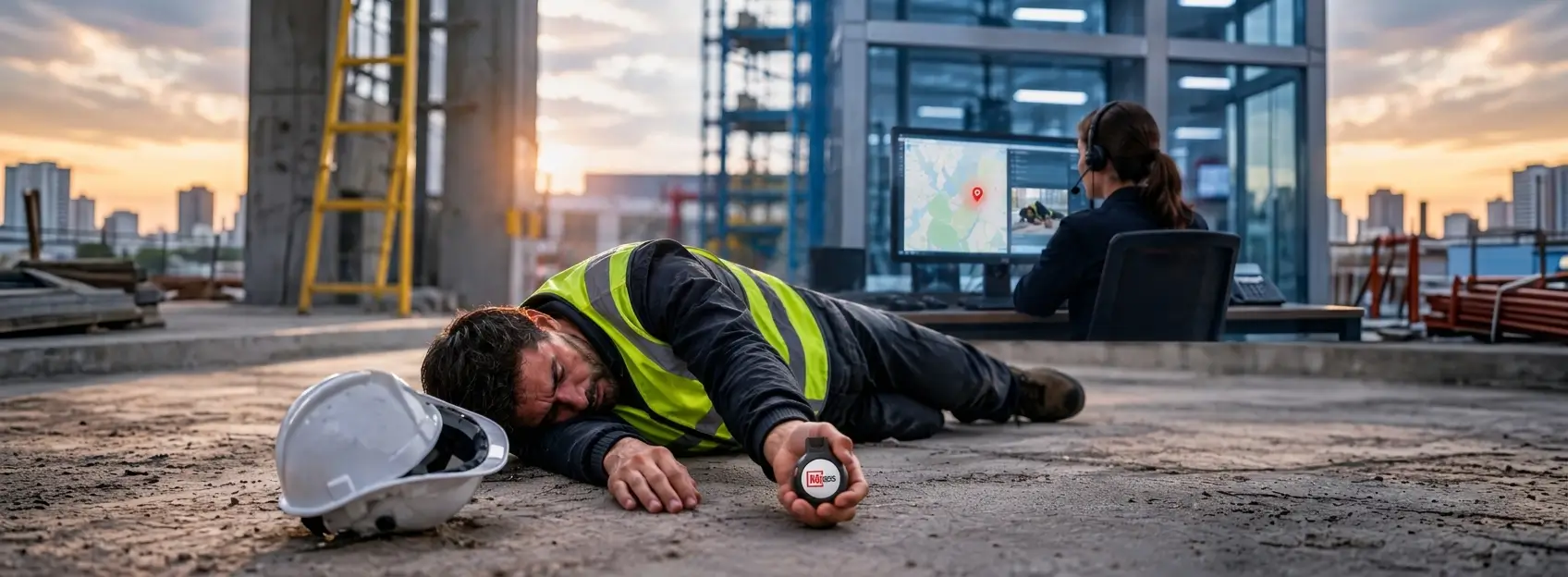
Working alone is common across security, facilities management, construction, healthcare, logistics, housing and field services. While lone working can be part of normal operations, it can also increase the consequences of an accident. If a worker falls, becomes injured or loses consciousness, there may be nobody nearby to provide immediate assistance.
This is where fall detection technology is becoming an important part of modern lone worker safety strategies.
Falls can happen in almost any working environment, from construction sites and warehouses to offices, plant rooms, stairways and remote properties. For a lone worker, the biggest risk may not always be the fall itself, but the delay in receiving assistance afterwards.
Traditional emergency procedures often depend on the employee recognising an incident and manually pressing an SOS button. However, an injured, unconscious or disorientated worker may not be able to raise an alarm.
Automated fall detection provides an additional layer of protection by helping identify a potential fall and triggering an alert when the worker may be unable to do so themselves.
Modern wearable safety technology uses sensors and intelligent algorithms to monitor movement. Depending on the device, sensors can detect sudden changes in movement, impact and body position that may indicate a fall.
When a potential fall is detected, the system can generate an alert. The worker may be given an opportunity to cancel the alert if they are safe. If there is no response, the alert can be escalated according to the organisation’s emergency response procedure.
This combination of real-time monitoring, automated alerts and location technology can help organisations respond more effectively to incidents involving employees working alone.
Fall detection is most effective when it forms part of a wider lone worker protection solution.
A modern system can combine:
Together, these features create a connected approach to employee safety, helping organisations move from reactive emergency response towards more proactive workplace risk management.
Consider a security officer conducting an overnight patrol alone. If they slip, fall and become unable to reach their phone, manually requesting assistance may not be possible.
With fall detection technology, a potential incident can automatically generate an alert. The monitoring team can receive information about the worker and their location, communicate with them where possible and follow the appropriate escalation procedure.
This can help reduce unnecessary delays and provide emergency responders with valuable information.
The principle is simple:
Detect → Alert → Locate → Communicate → Escalate → Respond
Technology does not replace appropriate risk assessments, training or emergency procedures, but it can strengthen the overall safety framework.
MiSentinelSOS is designed to provide connected protection for people working alone or in potentially high-risk environments.
The solution combines mobile technology with features including SOS alerts, GPS tracking, fall detection, no-motion detection, two-way communication, check-in/out and 24/7 monitoring.
Whether protecting security officers, facilities teams, field engineers, construction workers or housing staff, MiSentinelSOS helps organisations maintain communication and provide support when employees need it most.
As organisations continue to adopt connected worker technology, intelligent safety solutions and digital workplace safety tools, fall detection is becoming an increasingly valuable part of lone worker protection.
The objective is not simply to detect an accident. It is to help create a complete safety process that connects the worker with monitoring teams and emergency support as quickly as possible.
For employers, this can support their duty of care, improve incident management and strengthen their approach to workplace risk.
For employees, knowing that an automatic safety system is available can provide additional confidence when working alone.